
Documenting Cultural Properties in 3D
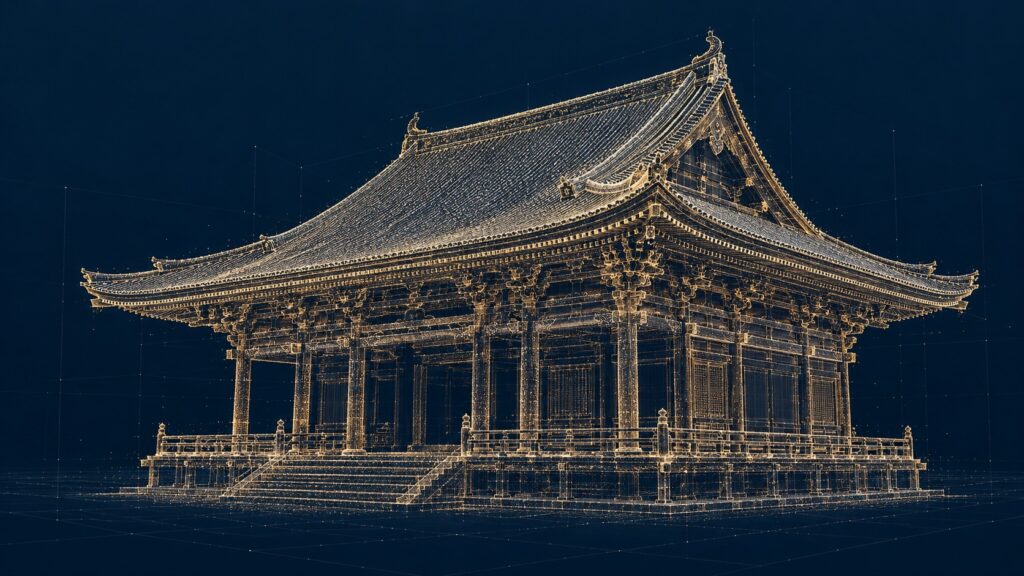
Historic buildings gradually change under rain and wind, earthquakes and fires, and the passage of time. That is why we record buildings as they are today in comprehensive, high-resolution 3D data.
Shapes and colors, every line of wood grain, even the marks etched into them. To preserve them just as they are, while they are still before us.
- RECORDRecord in 3D
- PROTECTProtect Against Tampering
- PASS ONPass On to the Future
How We Create Records
Digitizing cultural properties involves more than taking photographs. Through 3D scanning, photogrammetry, and precise records of color and material information, we recreate entire spaces digitally.
Alongside protecting cultural properties against the risk of loss from disasters or deterioration over time, this also opens up new ways to make them accessible, including through VR and the metaverse.
Main Initiatives
- Documentation using high-resolution 3D scanning and photogrammetry
- High-resolution 3D digitization of Important Cultural Properties
- Monitoring systems to record changes over time
- Research and documentation in collaboration with universities and educational institutions
- Development of a platform to make data available for research
Why We Keep Records
- When the Unexpected HappensRestoration
Even if a cultural property is lost to a disaster or another event, its records can provide reliable clues for restoration or reconstruction.
- For LearningLearning
Students can view and learn about cultural properties in a form close to the originals, without leaving the classroom.
- For the FutureLegacy
We can pass the scenes we see today on to generations yet to be born.
In collaboration with Hidenori Watanave's laboratory at the University of Tokyo Graduate School, we are working on 3D archives of cultural properties, including Nezu Shrine. We will advance the preservation of recorded data using blockchain technology to protect it against tampering.
Technology to Protect the Authenticity of Records
Major challenges for digital data include the risk of tampering and proving authenticity. The foundation is working on preservation using the following technologies.
We manage recorded data on distributed networks that do not depend on a single administrator, preserving it in a form protected against tampering.
We are working with technology partners to develop a system for verifying that records were made by real people, rather than generated by AI.