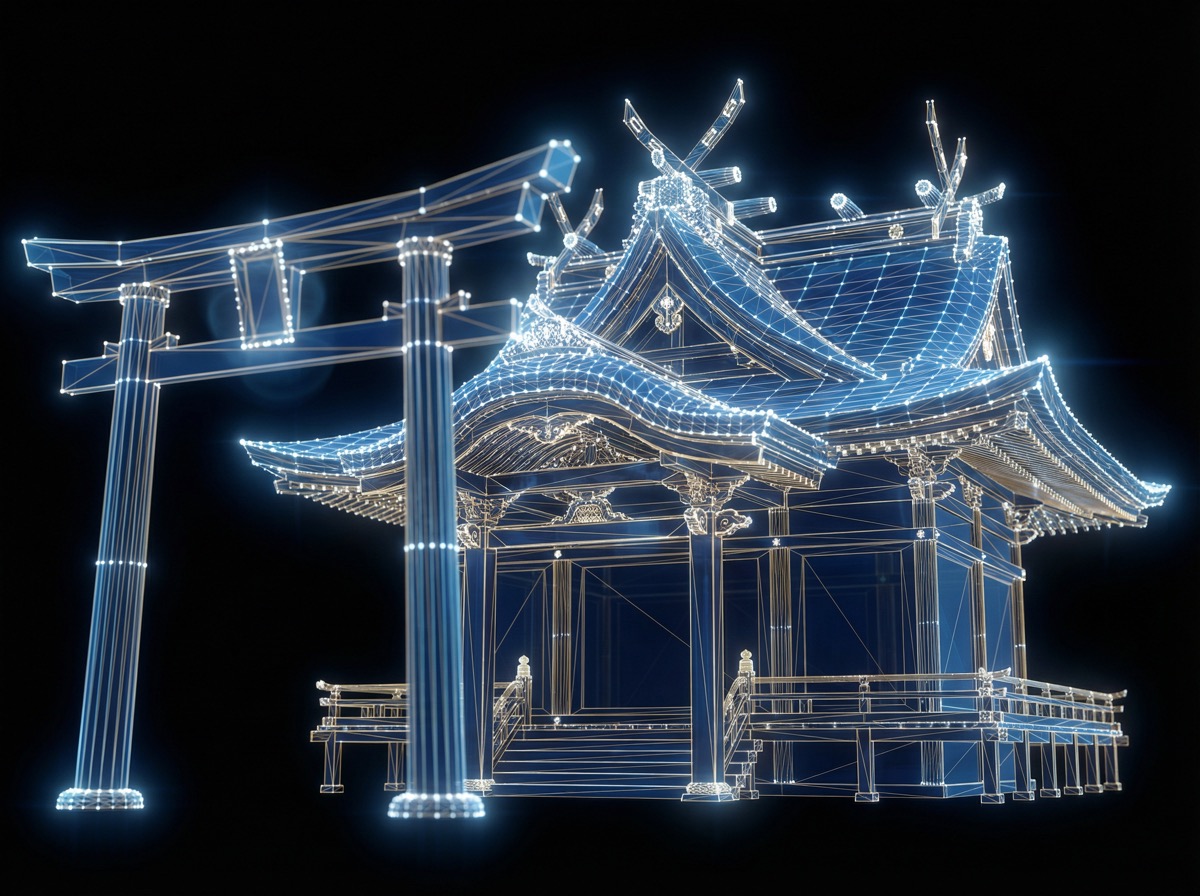
This fiscal year, your donations support two priority programs: building the foundations for AI literacy education, and preserving and documenting cultural heritage.
How Donations Are Used in Fiscal 2026
In fiscal 2026, your donations are being used for the following two priority programs. Progress updates and financial reports for each program will be published on the Public Disclosures page as they become available.
Use ① Building the Foundations for AI Literacy Education
AI literacy is not about the technical skills needed to use AI. It is about developing the ability to make your own judgments and take action without losing the values you cherish as a human being, even in an age of living alongside AI. Its guiding principles are NSV (the values axis) and SP (the action axis). For details, see the AIL Certification page.
1. Design and Operation of AIL Certification (AI Literacy Certification)
We are designing 4 levels: Citizen Foundation Level (general public and junior and senior high school students), Practical Application Level (working adults and local government staff), Educator Level (teachers and training instructors), and System Design Level (government officials and system designers). Fiscal 2026 is the design phase for the level structure, question-setting standards, and assessment methods. The opening date for exam applications will be announced on the AIL Certification page. While conventional AI certifications measure knowledge, operation, and efficiency, this certification assesses values, judgment, responsibility, and action through 4 pillars: knowledge, judgment, written responses, and practice.
2. Educator Training
Education for children cannot work without adults who have guiding principles. We will first ensure that educators and adults responsible for practical implementation can put the approach into practice, and then extend it to children. The training curriculum totals 20 hours across 5 phases: understanding the philosophy, understanding AI basics, teaching methods, assessment methods, and hands-on practice.
3. AI Literacy Education Research in Collaboration with the University of Tokyo
Under a collaboration agreement with Professor Hidenori Watanave of the University of Tokyo Graduate School, we will jointly advance educational research aimed at improving literacy across society in response to rapidly developing AI technology.
Specific Uses of Donations:
- Costs of designing certification question-setting and assessment standards, and operating the certification
- Costs of developing and delivering educator training curricula
- Costs of developing educational curricula on the ethical use of AI
- Costs of running practical internship programs for students
- Costs of developing AI literacy teaching materials through industry-academia collaboration and making them freely available
Use ② Preserving and Documenting Cultural Heritage
Digitizing cultural properties involves more than taking photographs. Through 3D scanning, photogrammetry, and precise records of color and material information, we recreate an entire space digitally. Records are managed on a distributed network that does not depend on a single administrator and are preserved in an unalterable state. For details of the technical foundations, see the Preservation Programs page.
1. Digital Archives of Historic Buildings
We are working on high-resolution 3D digitization of Important Cultural Properties, monitoring systems to record changes over time, and a platform to make data available for research. Through integration with World ID, we guarantee that these are authentic records created by real people rather than AI-generated data.
2. ONE WORLD Scholarly Archive Project
Under the supervision of Professor Hidenori Watanave of the University of Tokyo Graduate School, we will organize all records of the foundation's past cultural programs, including those at Tsukiji Hongwanji, Asakusa Shrine, Miidera Temple, and Tokyo Tower, into a scholarly cultural archive.
Specific Uses of Donations:
- Costs of measuring and documenting historic buildings through 3D laser scanning
- Costs of building and operating archive systems using blockchain technology
- Costs of issuing digital certificates for participating artists' works
- Development of infrastructure to provide open archives for researchers and educational institutions
A Request for Your Continued Support
Your support is essential to the ongoing operation of these priority programs. Each donation can make a significant contribution to the future of education and culture. We would be grateful for your continued support.
Note: The business plan and income and expenditure budget for fiscal 2026 (Reiwa 8; August 2026–July 2027) are being prepared for publication. Previously published plans and budgets are available on the Public Disclosures page.